Recent VC Vintages Struggle With TVPI Dip & Investment Valuations
Recent VC vintages struggle with a dip in TVPI—and with how to value their investments
Author: Kevin Dowd
Read time: 5 minutes
Published date: 5 November 2024
Distributions are a critical metric by which LPs measure the fund performance of VC funds. In recent years, however, they’re getting harder to find.
Contents
- Recent VC vintages struggle with a dip in TVPI—and with how to value their investments
- The calculus of TVPI
- Marks have grown more uncertain
- How VCs are approaching marks
When venture fund managers want to demonstrate how an active vehicle is performing, one of the most common tools they use is TVPI.
Short for total value to paid-in capital, TVPI is a metric that measures the current estimated value of a fund’s holdings in relation to the amount of capital contributed to the fund by its limited partners (LPs). A TVPI of 2x means that a fund’s estimated value is twice as high as the amount of capital that its investors put in. A TVPI of 1x means the fund has not increased the value of its LPs’ initial capital at all.
By this measure, last year was a challenging one for some of the most recent vintages of venture capital funds. As of Q1 2024, median TVPI for each of the 2018, 2019, and 2020 vintages had declined over the four most recent quarters (see left side of below chart). The dip was most significant for 2018 funds, where the median TVPI fell from 1.55x to 1.37x. That’s a decline in total fund value of more than 11%.
Another recent fund vintage, however, managed to avoid last year’s damage. The below chart shows that median TVPI among 2017 funds actually increased during the four most recent quarters, rising from 1.73x to 1.78x.
Funds from 2017 are older than other recent vintages, and have thus had more time to realize gains, which can improve current metrics. But the trend remains even if we take this difference in time into account. For instance, as you can see on the right side of the above chart, the median TVPI for 2017 funds was much higher at 20 months after inception than it was for 2018 or 2019 funds at the same point.
As of the end of Q1 2024, about 39% of all 2017 funds on Carta had a TVPI of 2x or higher, compared to 24% of 2018 funds and just 12% of 2019 funds. And a mere 12% of funds from 2017 had a TVPI lower than 1x. For more recent vintages, the picture isn’t quite so rosy.
The calculus of TVPI
While TVPI is one popular way to track fund performance, it’s not the only way. And it comes with certain limitations.
To calculate TVPI, fund managers use a mix of realized and unrealized gains. If the fund has already exited a portfolio company, then the gains on that particular investment are easy to measure: Just divide the realized return by the initial amount of capital paid in.
But if a fund still holds a company in its portfolio, calculating the value of potential unrealized gains is much trickier. To do so, fund managers typically mark the value of the company against the known valuation of other comparable companies in the market. The valuations of a company’s closest peers, the thinking goes, are probably a good proxy for valuing the company itself.
But fund managers use different methodologies for marking the values of their portfolio companies. There is no widely accepted industry standard. And no matter how accurate these marks are, they remain estimates and projections. A private company’s value will almost certainly change between any private mark and its ultimate exit. Accurately marking the value of private startups has grown even murkier in recent years, when valuations have seesawed across much of the tech landscape.
For LPs, knowing an active fund’s latest TVPI is certainly useful context. But it’s far from the only context required.
“With TVPI, a big question for LPs is, what are individual companies marked at?” says Stephanie Choo, a partner at fintech investor Portage who runs the firm’s early-stage team in North America. “Because it’s very hard to know how and when things will eventually exit.”
Marks have grown more uncertain
TVPI for more recent fund vintages can be heavily reliant on unrealized marks. And over the past few years, investors say that determining accurate marks for active portfolio companies has grown more difficult than ever.
If a startup raised capital in recent months, determining a fair valuation is often fairly easy: Just use the valuation that was assigned to the company during its fundraising. If it’s been a while since a startup last raised, then its owners will likely look to recent funding events from similar private companies as a comparison, or to valuations for peer companies that are publicly traded.
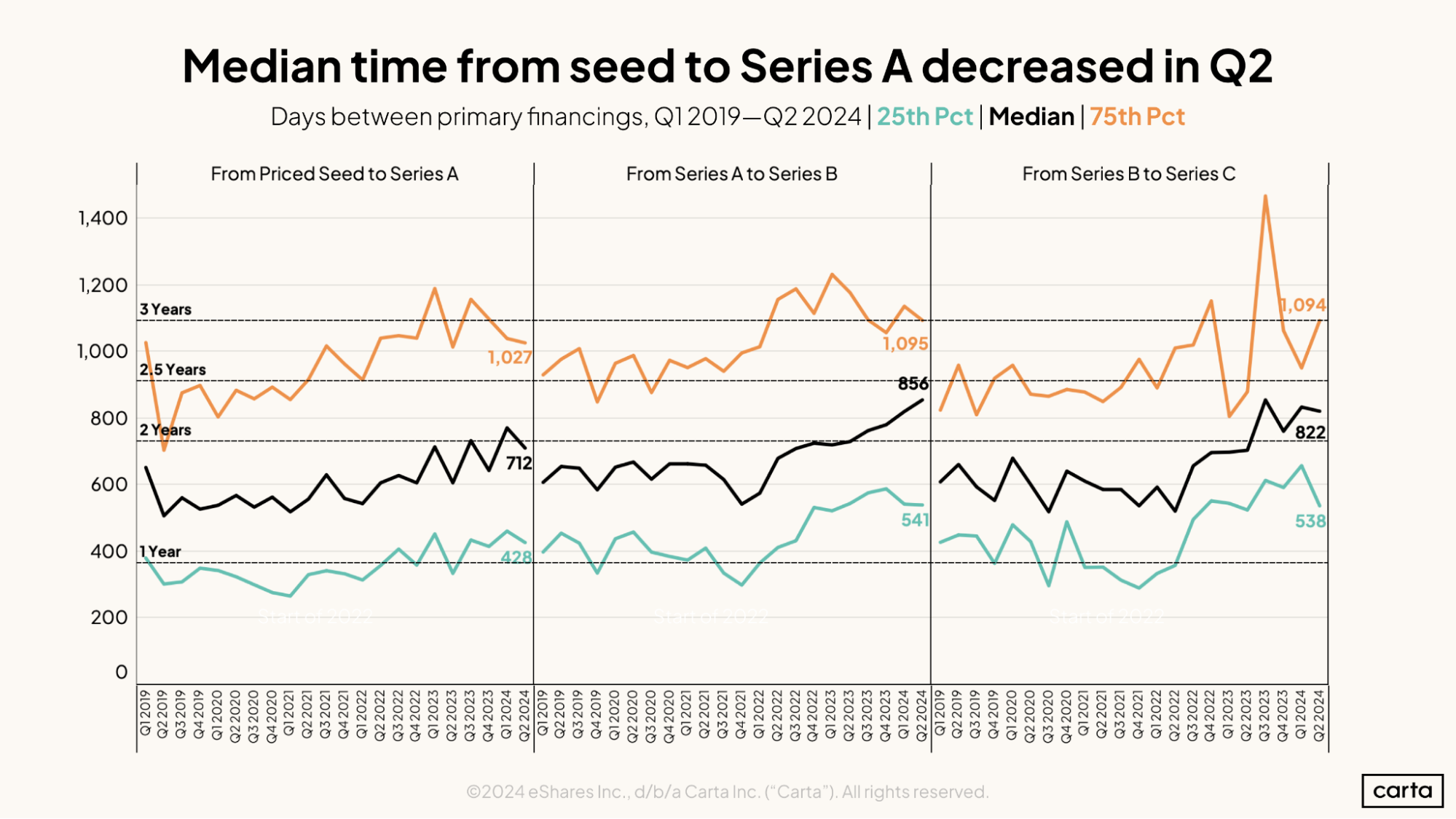
Over the past two years, however, the number of venture funding events taking place has steeply declined. Startups are waiting longer than ever between raising new rounds. And something of a dislocation has occurred between public and private markets, with stock indexes [soaring to record highs](https://finance.yahoo.com/quote/%5EGSPC/chart/?guccounter=1&guce_referrer=aHR0cHM6Ly93d3cuZ29vZ2xlLmNvbS8&guce_referrer_sig=AQAAAKFcQiq-6wjmC-Paci9iYlZdqXTS6m3Nk53GdloNYeptbDTKfxbeOFkmUIWlqJ6lrEvYwpN-xBEM4yaYRSfkfJcWJ0W037frR6dOmtCMX4RMUzS7F8Q2wGBDZ-pt4aRv_792Siy-IxvnI37pofZaID0Wmp09BxjY8PWn2RKZTo6u#eyJsYXlvdXQiOnsiaWludGVydmFsdCI6IndlZWsiLCJwZXJpb2RpY2l0eSI6eyJwZXJpb2QiOjEsInRpbWVVbml0Ijoid2VlayJ9LCJzaG93RXZlbnRzUXVvdGUiOmZhbHNlfSwib3V0bGllcnMiOmZhbHNlLCJhbmltYXRpb24iOnRydWUsImhlYWRzVXAiOnsic3RhdGljIjp0cnVlLCJkeW5hbWljIjpmYWxzZSwiZmxvYXRpbmciOmZhbHNlfSwibGluZVdpZHRoIjoyLCJmdWxsU2NyZWVuIjp0cnVlLCJzdHJpcGVkQmFja2dyb3VuZCI6dHJ1ZSwiY29sb3IiOiIjMDA4MWYyIiwic3ltYm9scyI6W3sic3ltYm9sIjoiXkdTUEMiLCJzeW1ib2xPYmplY3QiOnsic3ltYm9sIjoiXkdTUEMiLCJxdW90ZVR5cGUiOiJJTkRFWCIsImV4Y2hhbmdlVGltZVpvbmUiOiJBbWVyaWNhL05ld19Zb3JrIiwicGVyaW9kMSI6MTQxNjgxNjAwMCwicGVyaW9kMiI6MTcyNTk5NDgwMH0sInBlcmlvZGljaXR5IjoxLCJpbnRlcnZhbCI6IndlZWsiLCJ0aW1lVW5pdCI6bnVsbCwic2V0U3BhbiI6eyJtdWx0aXBsaWVyIjo1LCJiYXNlIjoieWVhciIsInBlcmlvZGljaXR5Ijp7InBlcmlvZCI6MSwidGltZVVuaXQiOiJ3ZWVrIn0sInNob3dFdmVudHNRdW90ZSI6ZmFsc2V9fV0sInN0dWRpZXMiOnsi4oCMdm9sIHVuZHLigIwifSwib0”,"shares":[]}