Inside the late-stage lull | Carta
Lack of exits, lower VC valuations are driving a late-stage lull
Author: Kevin Dowd
Read time: 4 minutes
Published date: May 22, 2024
At Series D and later, VC deal activity slowed down in Q1 2024. There are reasons for the decline on both sides of the negotiating table.
A decline in deal size
Late-stage funding rounds certainly do require "a significant amount of capital." But not quite as significant an amount as they used to.
The median Series D round size in Q1 fell to $22 million, a big drop from a median of $49 million in Q4 2023. At Series E+, meanwhile, the median round size was $45 million in Q1, compared to $59 million the prior quarter.
These are still larger round sizes than you’ll find at any other stage. But they’ve fallen off sharply in the past couple of years. Compared to Q4 2021—perhaps the peak of the late-stage market’s recent boom—median Series D round size has declined by 78%, and median Series E+ round size has fallen by 72%.
The role of IPOs
One reason that the late-stage market has slowed down: The IPO market has slowed down, too.
When fundraising activity surged at Series D and Series E+ in late 2020 and throughout 2021, it happened alongside a concurrent increase in IPOs. Late-stage private companies were flocking to the public markets and generating attractive returns for their investors—in some cases, only a few months after the initial investment. Other investors took note and pumped more capital into other late-stage companies in hopes of creating similarly swift returns themselves.
Lately, however, turning a quick profit through an IPO has proven more rare, because IPOs have become fewer and farther between. In 2023, just 108 companies raised $50 million or more in IPOs on U.S. exchanges, compared to 397 companies in 2021.
The lack of IPOs can make late-stage investing less appealing. It also means that some late-stage investors are squeezed for cash. If a VC’s existing investments aren’t returning capital, then they have less money to deploy in new deals.
The role of lower valuations
As with late-stage deal counts, late-stage valuations have fallen off since the 2021 bull market. At Series D, the median valuation on Carta sank to $212.1 million in Q1 2024, down from a high of $1.07 billion in Q3 2021.
Later stages are faring a little better. The median valuation in rounds at Series E+ rose to $841.2 million in Q1. That’s good for a 236% year-over-year increase, but it’s still well off the recent high of nearly $1.6 billion in Q2 2022.
In some ways, this reduction in late-stage valuations over the past two years is complementary to the reduction in late-stage deal count. Both trends are signs that VCs have grown less bullish about the market. When investors grow more selective, their universe of investment-grade companies shrinks, leading to fewer deals. And when competition for deals is less intense, VCs have more leverage in negotiations, which can drive down valuations.
But there can also be a cyclical effect, with lower valuations further driving down deal count. Some companies are wary about raising a new primary round in this environment because they’re concerned about the potential long-term impacts of a down round. If a company’s coffers are well stocked, leadership might choose to wait on raising new capital and use up some of its runway instead.
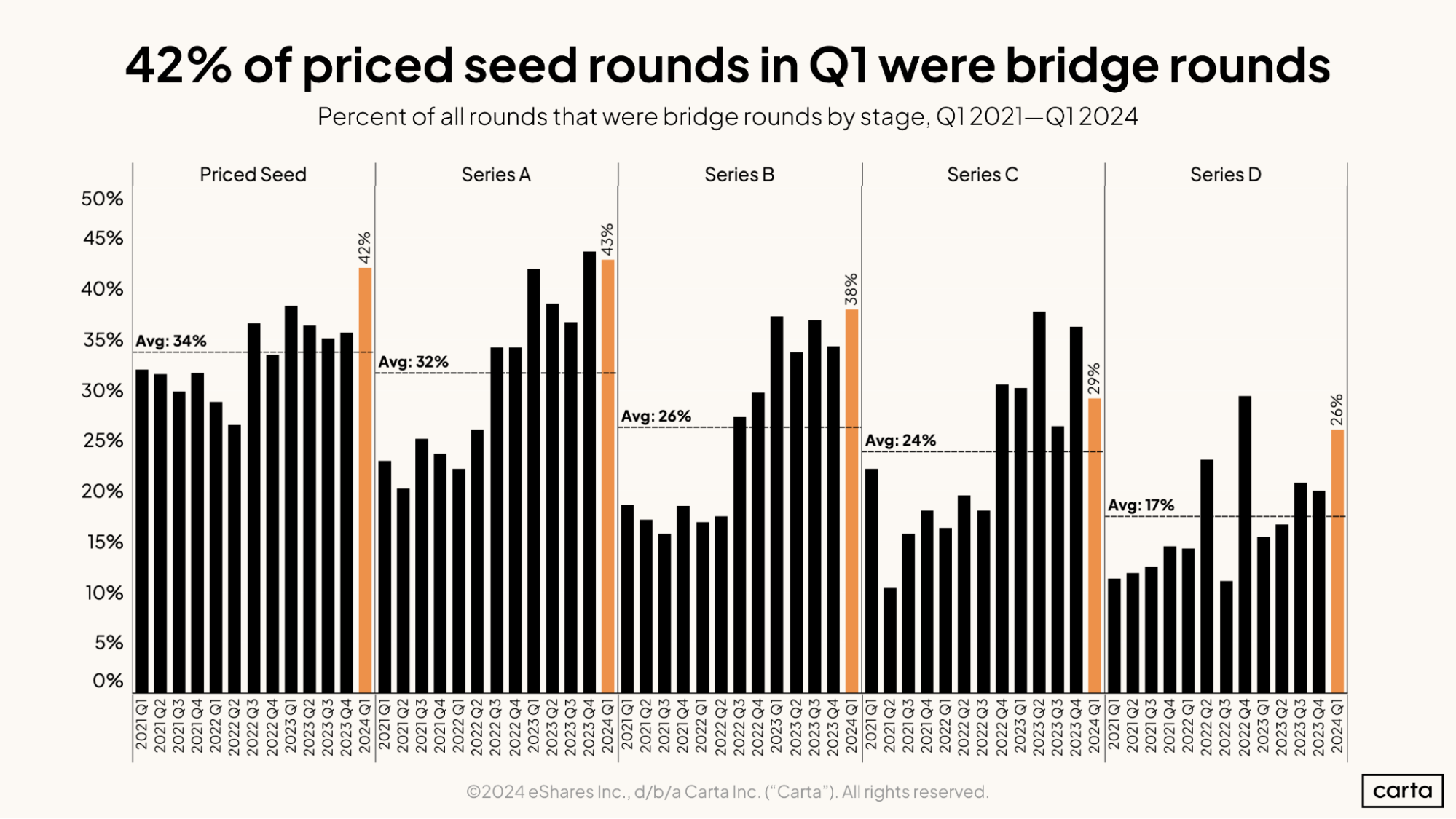
Other companies are opting to raise bridge rounds or other types of extensions to stay afloat without a new priced round. In Q1, about 26% of all new rounds raised by Series D companies on Carta were bridge rounds, up from 20% the previous quarter.
New market realities
This current cocktail of fewer deals, smaller deal sizes, and lower valuations might be hard to swallow for companies currently trying to raise a late-stage round.
The VC landscape looks very different from the last time many of these companies were on the fundraising trail.
“In that long, pre-pandemic bull market, there were high late-stage valuations, low sensitivity to core economics, and an almost perverse attraction to businesses that required a lot of capital,” Nash says. “The companies that were built on an assumption that they could snap their figures and raise the next round within six to 12 months—that is a big problem.”